Uber PM Mock Interview: Marketplace Cases, Jam Practice, and Scorecard
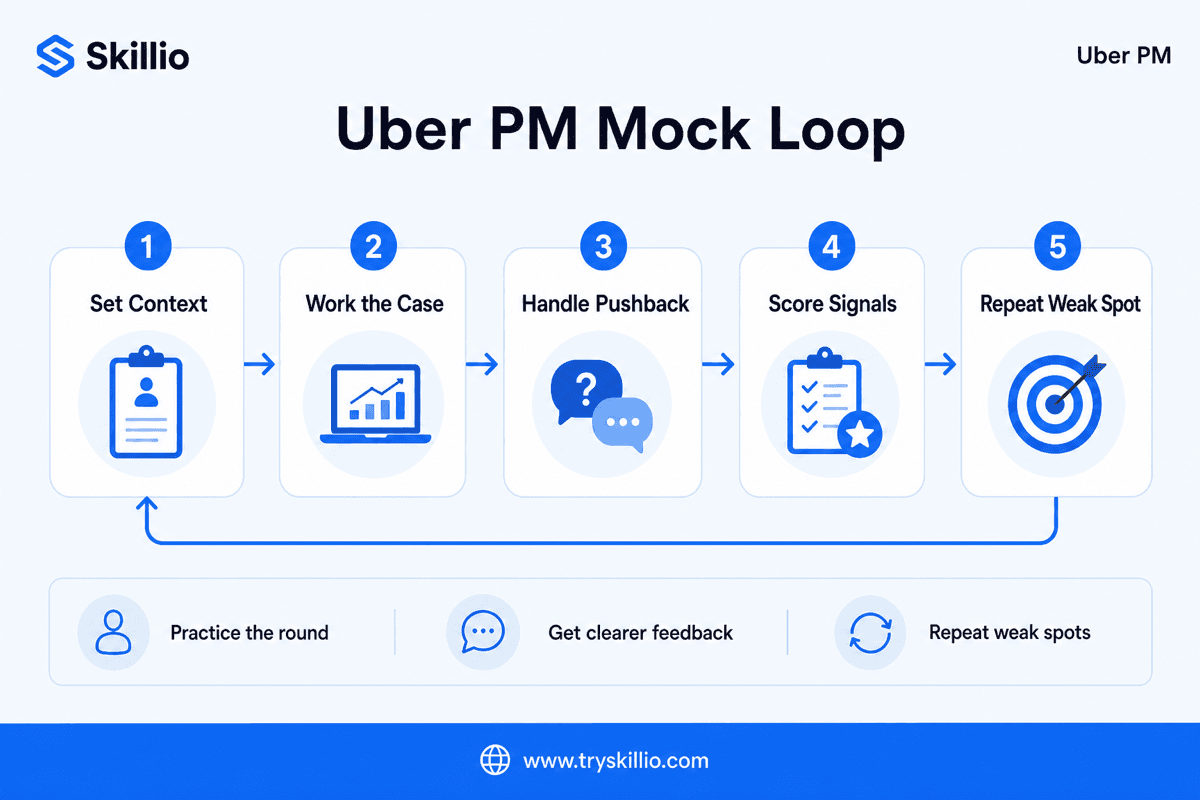
An effective Uber PM mock interview should test whether you can make a clear product decision inside a complex marketplace—not whether you can recite a framework. Choose one round type, define the marketplace participants and operating constraint, work the prompt aloud, handle pushback, and repeat the weakest part after feedback.
Uber's official hiring guidance says interviews focus on role-relevant problems, collaboration, decision-making, and real-world impact. PM-specific sources commonly add marketplace cases, metrics discussions, cross-functional interviews, and an Uber Jam or presentation-style exercise. The exact format varies by team, level, and role, so use this guide as a practice system rather than an official Uber scorecard.
What an Uber PM Mock Interview Should Test
| Signal | Strong Evidence | Weak Evidence |
|---|---|---|
| Problem framing | Defines the participant, market, constraint, and target outcome | Starts solving before clarifying the marketplace |
| Marketplace judgment | Balances effects across supply, demand, partners, and operations | Optimizes one side and ignores second-order effects |
| Metrics | Uses a primary metric, drivers, and guardrails to make a decision | Lists metrics without prioritizing or acting |
| Product recommendation | Chooses a focused path and names the tradeoff | Brainstorms features but avoids a decision |
| Practical execution | Accounts for operations, safety, incentives, technical limits, and rollout | Treats the problem as software-only |
| Communication and adaptability | Makes the reasoning clear and adjusts to new information | Gives a fixed monologue or becomes defensive |
The 50-Minute Uber PM Mock Interview Flow
| Segment | Time | What to Do |
|---|---|---|
| Set context | 3 minutes | Choose the team, market, level, round type, and target signal. |
| Clarify | 5 minutes | Define the participant, product goal, constraint, and missing information. |
| Structure | 5 minutes | State the decision path before exploring solutions. |
| Work the prompt | 20 minutes | Diagnose, compare options, recommend, and define measurement. |
| Pushback | 7 minutes | Add two constraints or challenge the candidate's assumptions. |
| Score and repeat | 10 minutes | Score the answer and redo the weakest three-to-five-minute segment. |
The interviewer should not rescue the candidate immediately. Allow enough ambiguity to expose whether the structure works under pressure.
Choose One Uber PM Mock Format
Marketplace product sense mock
Use this format to test user selection, product judgment, tradeoffs, and measurement across a multi-sided marketplace.
Representative prompt: Rider cancellations increased around large events. How would you improve the pickup experience without damaging driver earnings or city operations?
Listen for:
- Clear separation of riders, drivers, venue operators, and city constraints
- Diagnosis before feature design
- A focused target user and problem
- Second-order effects on supply, reliability, safety, and incentives
- A primary metric plus guardrails
Useful pushback:
- Driver supply is adequate, but drivers avoid the designated pickup zone.
- The city will not allow additional curb space.
- Your first pilot reduces wait time but increases driver cancellations.
Metrics and execution mock
Use this format to test metric definition, segmentation, causal reasoning, and action.
Representative prompt: Completed trips fell 7% in one city over the past two weeks. How would you investigate and respond?
Listen for:
- Confirmation of the metric definition and instrumentation
- Segmentation by time, geography, rider cohort, driver cohort, platform, and trip type
- A metric tree covering requests, matching, acceptance, pickup, cancellation, and completion
- Prioritized hypotheses rather than an unranked list
- A product or operational action tied to each likely outcome
Useful pushback:
- Requests and driver online hours are unchanged.
- The decline is concentrated at airports.
- The issue began after a dispatch change, but only on one platform.
Strategy mock
Use this format to test whether the candidate can make a recommendation under market and operating uncertainty.
Representative prompt: Should Uber launch a grocery-delivery product in a mid-sized market where Eats is established but courier availability is uneven?
Listen for:
- Clear decision criteria
- User need and market structure
- Merchant and courier density
- Economics, reliability, and competitive response
- A recommendation with a staged validation plan
- Conditions that would reverse the decision
Useful pushback:
- A competitor has exclusive relationships with the largest grocery chain.
- Existing couriers earn more during meal peaks than grocery windows.
- Early demand is strong, but substitution rates are high.
Uber Jam practice
PM-specific interview sources commonly describe the Jam as a prepared case presentation followed by questions. Confirm your actual format with the recruiter.
For a mock, give the candidate a case 24 hours in advance and ask for a 20-minute presentation followed by 15 minutes of questions.
Representative case: Build a plan to improve Uber Eats delivery reliability in suburban markets.
A useful presentation structure:
- Problem and target outcome
- Marketplace participants and constraints
- Evidence and root-cause hypotheses
- Options and tradeoffs
- Recommendation and MVP
- Measurement and guardrails
- Risks, rollout, and open questions
The mock interviewer should challenge the candidate's largest assumption, not the slide formatting.
Technical and data collaboration mock
Use this format to test product judgment at the boundary between users, systems, and data.
Representative prompt: Dispatch latency increased during peak demand. How would you work with engineering and data science to decide what to do?
Listen for:
- User and marketplace consequences of latency
- Clarification of which stage of the system slowed down
- Failure modes, data quality, and measurement
- Tradeoffs between reliability, accuracy, speed, and rollout risk
- Clear partnership roles without pretending Product owns the technical solution
Useful pushback:
- The faster model is less accurate in low-supply areas.
- The issue affects only older devices.
- A rollback restores speed but removes a fraud control.
Leadership and behavioral mock
Use this format to test ownership, influence, conflict, ambiguity, and learning.
Representative prompt: Tell me about a time you moved quickly on an ambiguous product problem and later changed your approach.
Listen for:
- Concrete context and stakes
- Personal product decision
- Real disagreement or constraint
- Measurable or observable result
- Honest reflection and changed behavior
Useful follow-ups:
- What did you personally decide?
- Which stakeholder disagreed, and why?
- What evidence changed your mind?
- What would you do differently now?
Uber PM Mock Interview Scorecard
Score each dimension from 1 to 4. The purpose is to select the next drill, not to manufacture a pass/fail prediction.
| Dimension | 1: Needs Work | 2: Developing | 3: Strong | 4: Standout |
|---|---|---|---|---|
| Framing | Solves an undefined problem | Clarifies basic context | Defines participant, goal, and constraint | Sharpens or reframes the decision productively |
| Marketplace reasoning | Treats one user in isolation | Names multiple sides but misses effects | Balances participants and key tradeoffs | Anticipates incentives and second-order effects |
| Metrics | Metrics are missing or disconnected | Names plausible measures | Uses primary metric, drivers, and guardrails | Uses metrics to diagnose, decide, and adapt |
| Recommendation | Avoids a choice | Chooses with limited support | Prioritizes with clear rationale | Makes a crisp decision and states reversal conditions |
| Execution | Generic launch plan | Some sequencing and risk | Practical MVP, dependencies, rollout, and learning | Integrates product, operations, technical, and market risk |
| Communication | Hard to follow or overly scripted | Mostly clear | Structured, concise, and collaborative | Adapts visibly without losing the decision thread |
After the mock, answer four questions:
- Where did the candidate make the clearest product decision?
- Where did the reasoning become generic or disconnected from Uber's marketplace?
- Which assumption failed under pushback?
- What three-to-five-minute segment should be repeated immediately?
How to Give Useful Feedback
Feedback should point to an observable moment and a next action.
| Vague Feedback | Better Feedback |
|---|---|
| Think more about the marketplace. | You chose riders but never explained the effect on drivers. Add a supply-side guardrail before recommending the feature. |
| Use more metrics. | You listed six metrics but did not choose the one that determines whether to launch. Select a primary outcome and two guardrails. |
| Be more strategic. | You compared options but avoided a recommendation. Choose one path and name the assumption that could reverse it. |
| Go deeper technically. | You named latency but did not connect it to matching quality or cancellations. Explain the user and product consequence first. |
| Show more leadership. | The story describes the team but not your decision. State what you owned, the disagreement, and the result. |
A Two-Week Uber PM Mock Plan
| Day | Practice |
|---|---|
| 1 | Baseline marketplace product mock |
| 2 | Repeat participant mapping and prioritization only |
| 3 | Metrics diagnosis mock for Rides |
| 4 | Metrics diagnosis mock for Eats |
| 5 | Behavioral stories: ownership and conflict |
| 6 | Strategy recommendation with a city-level constraint |
| 7 | Review scorecards and choose the recurring weakness |
| 8 | Jam case outline and 10-minute practice presentation |
| 9 | Full Jam presentation with pushback |
| 10 | Technical/data collaboration mock |
| 11 | Marketplace product mock with a safety constraint |
| 12 | Behavioral mock with deeper follow-ups |
| 13 | Full 50-minute simulation |
| 14 | Targeted repeat of the lowest-scoring segment |
Use Skillio to run an Uber-specific mock, review the feedback by signal, and repeat the weakest part with a changed marketplace constraint. Do not switch to a new prompt merely because the first attempt felt uncomfortable.
Common Uber PM Mock Interview Mistakes
- Practicing a generic consumer product prompt with no marketplace participants.
- Treating the Jam as a presentation contest rather than a working discussion.
- Naming supply and demand without explaining how the recommendation changes them.
- Choosing metrics that do not determine the product decision.
- Ignoring safety, fraud, regulation, reliability, or operations.
- Giving the candidate no pushback, then overrating a smooth first answer.
- Moving to another prompt instead of repeating the weak segment.
- Pretending every Uber PM team uses the same loop or technical depth.
Uber PM Mock Interview FAQs
How long should an Uber PM mock interview be?
Use about 50 minutes for a focused product, metrics, strategy, or technical round. A Jam simulation may require preparation in advance, a 20-minute presentation, and 15 minutes of questions plus feedback.
What should I practice for an Uber PM mock interview?
Practice marketplace product sense, metrics and execution, strategy, Jam or case presentation, technical/data collaboration, and leadership. Prioritize the rounds your recruiter identifies for your team.
Is the Uber Jam guaranteed for every PM candidate?
No. PM-specific sources commonly describe it, but Uber's official hiring guidance says functional exercises are role dependent. Confirm the actual process with your recruiter.
Are these official Uber PM prompts?
No. They are representative practice prompts designed around recurring public themes. They should not be treated as official or guaranteed questions.
How should I practice marketplace thinking?
For every prompt, name the marketplace participants, identify the constrained side, predict second-order effects, and choose a primary metric plus guardrails for the other participants.
How many mocks should I complete?
Complete enough scored mocks to identify and improve a recurring weakness. A smaller number of focused mocks with immediate repeats is usually more useful than many unrelated sessions.