Uber PM Interview Questions: 45+ Marketplace, Metrics, and Jam Prompts
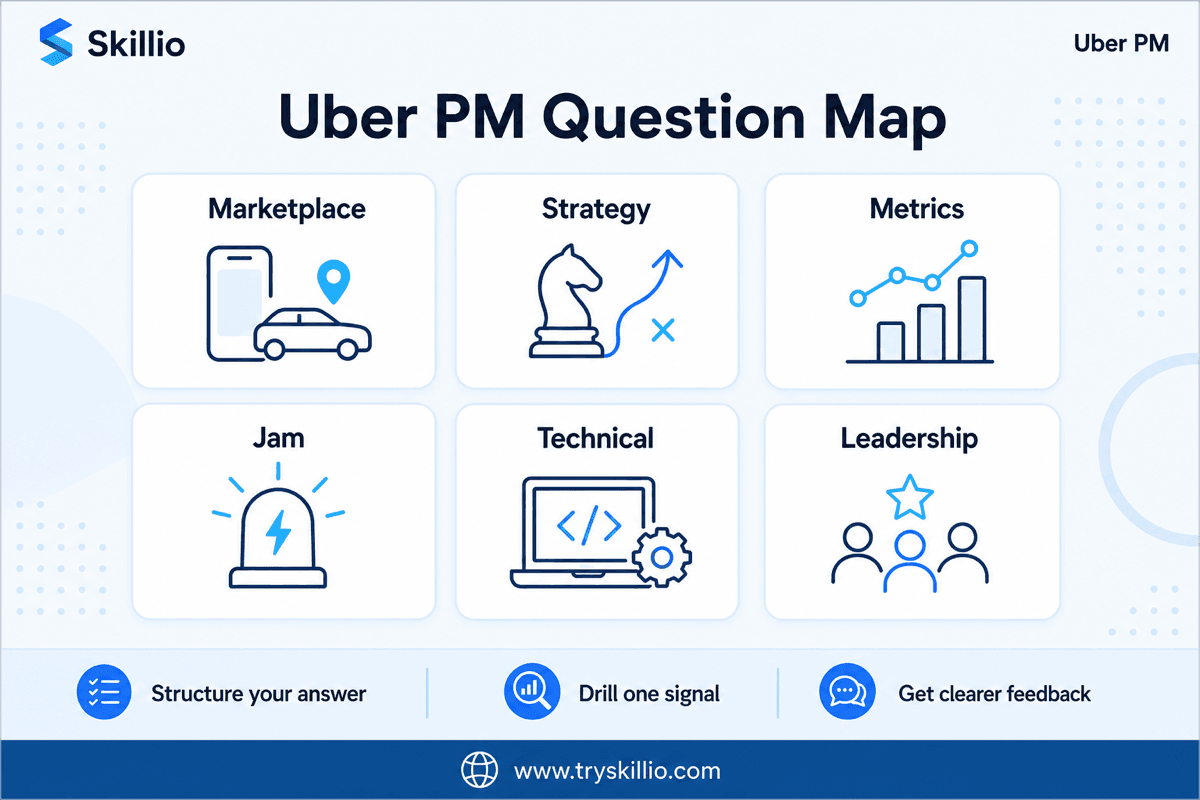
Uber PM interview questions often look like familiar product sense, strategy, metrics, technical collaboration, and behavioral prompts. What makes them different is the operating context: Uber products connect multiple marketplace participants and must work through pricing, supply, demand, reliability, safety, logistics, and city-level variation in the real world.
The questions below are representative practice prompts built from commonly reported Uber PM interview themes. They are not official Uber questions, leaked material, or a guaranteed interview script. The mix can vary by product, team, level, location, and interviewer.
Before practicing, review the Uber PM interview process so you know where a product case, Jam-style presentation, technical conversation, or behavioral round may appear.
Uber PM Interview Question Types
| Question Type | What It Tests | Common Weak Signal |
|---|---|---|
| Marketplace product design | User judgment, problem framing, prioritization, and second-order effects | Solves for one participant while harming another |
| Strategy and growth | Market reasoning, launch choices, incentives, and recommendations | Generic strategy with no operational detail |
| Metrics and execution | Metric trees, diagnosis, experiments, and action | Lists metrics without a decision path |
| Jam or product case | Structured thinking, presentation, pushback, and adaptability | Polished deck that cannot handle challenge |
| Technical and data collaboration | Product implications of systems, data, latency, and risk | Pretends to be the engineer or stays too shallow |
| Leadership and behavioral | Ownership, conflict, ambiguity, influence, and reflection | Vague story with no personal decision or result |
Marketplace Product Design Questions
Uber product decisions can affect riders, drivers, consumers, couriers, restaurants, merchants, and internal operations at the same time. Start by naming the participants and the constraint before proposing features.
Representative practice prompts
- How would you reduce ride cancellations without lowering driver earnings or rider trust?
- Design a better pickup experience for a stadium event with more than 10,000 attendees.
- How would you improve Uber Eats for customers ordering in suburban markets?
- Design a product that helps drivers understand and improve their performance.
- How would you improve airport pickups for riders, drivers, and airport operations?
- Design a way for a rider to request and manage a trip for someone else.
- How would you improve restaurant onboarding without reducing marketplace quality?
- Design a safer late-night ride experience for both riders and drivers.
How to answer
- Clarify the market, product surface, and target outcome.
- Map the marketplace participants and identify the constrained side.
- Choose one priority user and problem while naming second-order effects.
- Generate a small set of approaches and compare them using impact, risk, effort, and marketplace health.
- Recommend a focused solution with a primary metric and guardrails.
- Explain how you would test the riskiest assumption before scaling.
Common pitfalls
- Treating Uber like a single-user consumer app.
- Ignoring incentives, safety, reliability, or operations.
- Assuming supply can increase instantly.
- Optimizing conversion while hurting completion or trust.
- Proposing a global launch without considering city variation.
Strategy and Growth Questions
Strategy prompts test whether you can make a clear recommendation when market, operational, and product constraints collide.
Representative practice prompts
- Should Uber enter a new grocery-delivery market? How would you decide?
- How should Uber increase Uber One adoption without training users to wait for discounts?
- Should Uber offer vehicles or financing products to drivers who do not own a car?
- How would you grow Uber in a city where rider demand is strong but driver supply is inconsistent?
- What should Uber's product strategy be for autonomous vehicles during the next three years?
- How would you increase revenue per Uber Eats order while protecting retention?
- Should Uber build, buy, or partner for a new logistics capability?
- How would you respond if a competitor offered drivers materially better incentives in one market?
How to answer
Define the decision before analyzing it. Then compare user need, marketplace health, market size, strategic fit, operating constraints, competitive response, and risk. Make a recommendation rather than ending with a list of considerations.
A strong answer also states what would change the decision. For example, a new-market recommendation may depend on courier supply, merchant density, unit economics, regulation, or the ability to reach reliable delivery times.
Common pitfalls
- Giving a feature roadmap instead of a strategy.
- Ignoring the economics or supply side of the marketplace.
- Using global averages for a city-level decision.
- Refusing to choose because the data is incomplete.
- Naming AI as a strategy without a user or operating advantage.
Metrics and Execution Questions
Uber PMs work with products where one outcome can be driven by user behavior, marketplace liquidity, pricing, dispatch, operational conditions, or instrumentation. Build a metric tree before choosing a fix.
Representative practice prompts
- Gross ride bookings fell 8% week over week. How would you investigate?
- Rider wait time increased in one city. What would you analyze first?
- Uber Eats delivery completion is stable, but repeat ordering declined. How would you diagnose it?
- How would you measure the success of scheduled rides?
- Driver supply is falling in a neighborhood during peak demand. What might be happening?
- How would you evaluate a new rider-referral program?
- What metrics would you use for a feature that lets people order rides for others?
- How would you test whether a new pickup flow reduces cancellations?
Build an Uber-specific metric tree
For a rides problem, useful branches may include:
- Demand: requests, active riders, frequency, and conversion
- Supply: active drivers, online time, utilization, and geographic availability
- Matching: time to match, acceptance, reassignment, and dispatch quality
- Trip: pickup time, completion, cancellations, duration, and safety
- Economics: price, incentives, earnings, promotions, and contribution
- Experience: support contacts, ratings, trust, and retention
For Eats, add merchant availability, menu quality, preparation time, courier assignment, batching, delivery time, order accuracy, and refunds.
Common pitfalls
- Listing dashboards before confirming the metric definition.
- Failing to check instrumentation or seasonality.
- Mixing correlation with cause.
- Ignoring geography, cohort, platform, product, or time segmentation.
- Ending with analysis instead of a product or operational decision.
Uber Jam and Product Case Questions
Uber's official hiring guidance says some roles include a job-related exercise or work simulation. PM-specific sources commonly describe a Jam or case presentation where candidates present a recommendation and respond to follow-up questions. The exact format is role dependent.
Representative practice prompts
- Build a plan to quadruple adoption of a grocery product within Uber.
- Design a program that rewards long-term drivers without creating harmful incentives.
- Uber Eats engagement is weak in suburbs. Diagnose the problem and recommend a plan.
- Create a product roadmap to improve trip reliability during major city events.
- Recommend how Uber should launch a new mobility product in one market.
- Improve airport pickup efficiency while working within local operating rules.
- Develop a plan to reduce late deliveries without increasing courier churn.
- Decide whether Uber should introduce a new ad placement on a high-traffic product surface.
How to structure the case
| Section | What to Cover |
|---|---|
| Problem | User, marketplace participants, current pain, and target outcome |
| Diagnosis | Evidence, segments, root-cause hypotheses, and missing information |
| Options | Two or three plausible approaches with tradeoffs |
| Recommendation | Chosen path, why now, and what you are not doing |
| Execution | MVP, sequencing, dependencies, and operating plan |
| Measurement | Primary metric, guardrails, experiment, and review cadence |
| Risks | Safety, incentives, fraud, reliability, regulation, and unintended effects |
During pushback, do not defend every slide. Clarify whether the new information changes your premise, your priority, or only the execution detail. Adapt explicitly.
Technical and Data Collaboration Questions
Technical depth varies by role. These prompts test whether you can work effectively with engineers and data scientists and understand the product consequences of technical choices.
Representative practice prompts
- Explain the product considerations in matching riders with drivers in real time.
- How would you prevent fraud in an Uber gift-card or credits system?
- What product tradeoffs matter when dispatch latency increases?
- How would you design a leadership dashboard for city profitability and marketplace health?
- A model predicts late deliveries. How would you decide whether and how to use it in the product?
- How would you work with data science to test whether late delivery causes customer churn?
- Tell me about a product you designed around incomplete or unreliable data.
- How would you prioritize reliability work against a highly requested new feature?
How to answer
Stay at the product-and-system boundary. Clarify the user outcome, the system constraint, failure modes, data requirements, and decision tradeoffs. Ask what the engineering or data partner needs from Product, then explain how you would sequence discovery and delivery.
Do not bluff about an unfamiliar technical detail. State what you know, identify the uncertainty, and show how you would make the decision with the right partner.
Leadership and Behavioral Questions
Uber's official hiring page emphasizes clear thinking, collaboration, adaptability, and real-world impact. Behavioral questions are your opportunity to show those qualities through specific product decisions.
Representative practice prompts
- Tell me about a time you influenced a team without direct authority.
- Describe a disagreement with engineering or design about a product decision.
- Tell me about a time you moved quickly with incomplete information.
- Describe a launch that did not produce the expected result.
- Tell me about a time you used data to change a stakeholder's mind.
- Describe a difficult prioritization decision that disappointed an important stakeholder.
- Tell me about a time you balanced a short-term target with long-term product health.
- Describe a product decision where your first approach was wrong.
Build stronger stories
Use a simple structure:
- Context: What was the product, user, decision, and constraint?
- Tension: Why was the answer not obvious? Who disagreed and what was at risk?
- Action: What did you personally decide, communicate, or change?
- Result: What measurable or observable outcome followed?
- Reflection: What did you learn, and how did it change your later judgment?
Avoid stories where the conflict disappears, the team does all the work, or the result is “everyone agreed.”
How to Practice Uber PM Interview Questions
Do not practice all 48 prompts once. Build repeatable skill by category.
| Practice Stage | Activity | Goal |
|---|---|---|
| Baseline | Answer one product, metrics, strategy, and behavioral prompt | Identify the weakest signal |
| Focused drills | Repeat three prompts from the weakest category | Build a reliable decision structure |
| Pushback | Add a new constraint five minutes before the end | Test adaptability |
| Jam simulation | Prepare and present one case, then take questions | Practice recommendation and defense |
| Full mock | Run one timed round with feedback only at the end | Test performance under realistic conditions |
Use Skillio to practice an Uber-specific round, review where your reasoning became generic, and repeat the weakest part with a new marketplace constraint. The goal is not to memorize an answer. It is to make your choices, metrics, and tradeoffs clearer under pressure.
A One-Week Uber PM Practice Plan
| Day | Focus |
|---|---|
| 1 | Marketplace product design and participant mapping |
| 2 | Metrics trees for Rides and Eats |
| 3 | Strategy recommendation and city-level variation |
| 4 | Jam case outline, presentation, and pushback |
| 5 | Technical/data collaboration and operating risks |
| 6 | Behavioral stories with ownership and measurable outcomes |
| 7 | One full Uber PM mock interview and a targeted repeat |
Uber PM Interview Questions FAQs
What questions are asked in an Uber PM interview?
Candidates commonly prepare for marketplace product design, strategy, metrics and execution, Jam or case work, technical/data collaboration, and leadership questions. The actual mix varies by team and level.
Are these official Uber interview questions?
No. These are representative practice prompts based on recurring public interview themes. They are not an official Uber question bank or a guaranteed set of questions.
What makes Uber PM questions different?
Uber questions often require reasoning across multi-sided marketplaces and real-world constraints such as supply, demand, pricing, incentives, reliability, safety, operations, and city-level variation.
What is the Uber Jam?
PM-specific interview sources commonly describe the Uber Jam as a case or presentation-style discussion followed by questions and pushback. Uber's official hiring guidance says job-related exercises are role dependent, so confirm the format with your recruiter.
How technical is the Uber PM interview?
Technical depth depends on the team and role. Candidates may need to discuss systems, data, experimentation, latency, fraud, or architecture implications with engineering and data partners, but a PM is not usually being evaluated as a software engineer.
How many questions should I practice?
Practice enough to build a repeatable structure in each category. Deliberate repetition with feedback is more valuable than racing through a large list once.