Uber PM Interview Process: Rounds, Jam, Timeline, and Prep
Preparing for an Uber PM interview is different from preparing for a generic product management interview. You still need product sense, analytics, strategy, and behavioral stories, but Uber also tests whether you can reason through real marketplace constraints: supply and demand, incentives, reliability, city-level differences, operations, and cross-functional tradeoffs.
This guide breaks down the Uber PM interview process, including the recruiter screen, hiring manager or PM screen, Uber Jam or case-style exercise, final loop interviews, decision process, timeline, and preparation approach.
The exact process can vary by team, level, location, and hiring cycle, so use this as a practical map rather than a fixed promise.
Uber PM Interview Process Overview
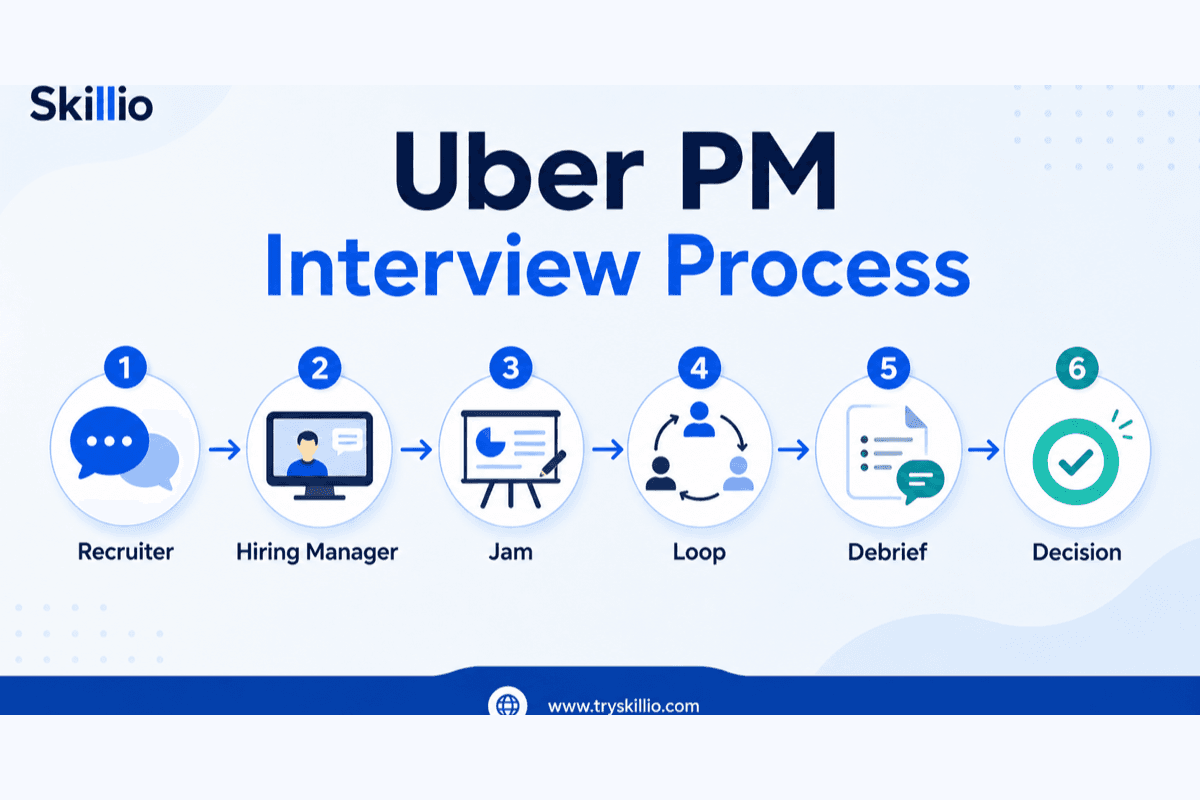
The Uber PM interview process commonly starts with a recruiter or sourcer conversation, then moves into a hiring manager or PM screen. After that, candidates may receive a role-dependent case, functional exercise, or Uber Jam-style presentation before moving into a final loop with PM and cross-functional interviewers.
Uber's official hiring guidance describes a broader sequence: apply, talk with the talent team, meet the hiring manager, complete role-dependent exercises when needed, meet teammates or cross-functional partners, and wait for a recruiter-led decision. PM-specific interview sources add the Uber-specific details: the Jam, marketplace case work, and loop interviews focused on product judgment, metrics, strategy, execution, collaboration, and leadership.
The timeline varies. Some candidates may move through the process in several weeks. Other sources describe a longer process that can stretch toward two or three months depending on role, scheduling, level, and location.
| Stage | What Happens | Expected Timeline |
|---|---|---|
| Application / Resume Screen | Uber reviews your background against the open Product role. | Variable |
| Recruiter / Sourcer Screen | You discuss your background, role fit, motivation, and logistics. | 30-45 minutes |
| Hiring Manager / PM Screen | A manager or PM evaluates product judgment, communication, and team fit. | 30-45 minutes |
| Case / Functional Exercise / Uber Jam | You may prepare and present product thinking, then handle follow-up questions. | Role dependent |
| Final Loop / Team Interviews | You meet PM and cross-functional interviewers across product, metrics, strategy, collaboration, and behavioral areas. | Several interviews |
| Decision / Debrief | The recruiter and hiring team review feedback and communicate next steps. | Variable |
Stage 1: Application and Resume Screen
What happens
Uber reviews your application and resume to decide whether your background fits the open Product Manager role. For PM candidates, this screen is not just about whether you have held a product title. It is about whether your experience maps to the scope of the team, the product surface, and the type of problems Uber needs someone to solve.
What Uber is evaluating
Uber is looking for signs of product ownership, measurable impact, relevant domain experience, and clear scope. Marketplace, consumer, logistics, growth, platform, data-heavy, or operations-heavy product work can be especially useful when it is relevant to the role.
How to think about this stage
Your resume should make it easy to see what you owned, what changed because of your work, and how you made decisions. Generic bullet points are weak here. Uber PM work often sits at the intersection of users, operations, engineering, data science, and business goals, so the strongest resumes show cross-functional product impact.
Weak signals or mistakes to avoid
- Listing responsibilities without measurable outcomes.
- Hiding the product problem behind internal project names.
- Overstating ownership when the role was mostly support.
- Failing to connect prior work to Uber's product environment.
Stage 2: Recruiter or Sourcer Screen
What happens
The first live conversation is usually with a recruiter or sourcer. Uber's Product careers page describes this initial call as a virtual conversation where the recruiter learns about your background and skill set as they relate to the role. PM-specific sources commonly describe this as a short screen focused on your experience, motivation, and fit.
What Uber is evaluating
This round checks whether your background is credible for the role, whether you can explain your PM story clearly, and whether your motivation for Uber is specific. It can also cover level alignment, location, compensation, timing, and process logistics.
How to think about this stage
Prepare a short, high-signal version of your product story. You should be ready to explain what products you have worked on, what scope you owned, what metrics mattered, what tradeoffs you made, and why Uber is the right next move.
Sample question or prompt
Tell me about yourself and why you are interested in a PM role at Uber.
Weak signals or mistakes to avoid
- Giving a long career history with no product through-line.
- Saying you like Uber only because it is a large brand.
- Describing impact without metrics.
- Not having questions about the team, product area, or interview loop.
Stage 3: Hiring Manager or PM Screen
What happens
After the recruiter screen, candidates may speak with a hiring manager, senior PM, or PM interviewer. This round often goes deeper into product judgment and team fit. Depending on the role, it may include product questions, metrics discussion, behavioral questions, or a lighter case-style prompt.
What Uber is evaluating
Uber is evaluating whether you can structure product thinking in a way that fits a marketplace business. Good candidates do not just suggest features. They identify the user, clarify the marketplace participants, define the metric, reason through supply and demand, and explain the tradeoff they would make.
How to think about this stage
Expect your interviewer to care about how you think as much as what answer you reach. If the prompt is about rider pickup, delivery reliability, driver earnings, merchant onboarding, or marketplace efficiency, do not treat it as a simple consumer-app feature question. Ask what side of the marketplace is constrained and what metric needs to move.
Sample question or prompt
How would you improve the pickup experience for riders and drivers in a dense city?
Weak signals or mistakes to avoid
- Jumping to features before diagnosing the marketplace problem.
- Optimizing for one side of the marketplace while ignoring another.
- Using generic product frameworks without Uber-specific reasoning.
- Failing to name success metrics.
Stage 4: Case, Functional Exercise, or Uber Jam
What happens
For PM candidates, one of the most distinctive parts of the process is the Uber Jam or a related case-style exercise. Sources describe this as a prepared product challenge where the candidate presents structured thinking and then responds to interviewer questions.
The exact format can vary. Some candidates may receive a take-home case. Some may have a Jam-style presentation. Some may see a role-dependent functional exercise. Uber's official hiring guidance leaves room for role-specific assessments, while PM-specific sources consistently call out the Jam as an important Uber PM interview element.
What Uber is evaluating
The Jam tests more than presentation polish. Uber wants to see how you frame an ambiguous product problem, reason through marketplace tradeoffs, choose metrics, prioritize options, and respond when interviewers challenge your assumptions.
How to think about this stage
Treat the Jam like a working session, not a speech. You need a clear recommendation, but you also need to show how you got there and how you adapt when new information appears. For Uber, that usually means thinking through multiple participants: riders and drivers for Rides, or consumers, couriers, restaurants, and merchants for Eats and delivery products.
Sample question or prompt
Uber Eats delivery times have increased in a major city. How would you diagnose the problem and decide what to do next?
Weak signals or mistakes to avoid
- Presenting a polished answer that cannot handle follow-up questions.
- Ignoring operational constraints.
- Forgetting marketplace incentives.
- Choosing metrics that do not connect to the recommendation.
Stage 5: Final Loop and Team Interviews
What happens
The final loop may include several interviews with PMs and cross-functional partners. PM-specific sources commonly describe three to four loop interviews, but the exact number can vary. Depending on role and level, candidates may meet people from product, engineering, data science, design, operations, marketing, or leadership.
What Uber is evaluating
The loop tests whether your product judgment holds up across different kinds of conversations. One interviewer may focus on product design. Another may test metrics and execution. Another may go deep on strategy, technical collaboration, data, or behavioral leadership.
How to think about this stage
Do not prepare for the loop as one generic PM interview. Prepare by round type. Uber PMs work in a fast-moving environment where product decisions often affect many stakeholders at once, so your answers should show structured thinking, practical tradeoffs, and the ability to work across functions.
| Round | Interview Type | Interviewer | What It Tests |
|---|---|---|---|
| Uber Jam / Product Case | Prepared or semi-prepared case discussion | PM or panel | Problem framing, marketplace tradeoffs, metrics, and response to pushback |
| Product Design / Product Sense | Product improvement or design prompt | PM | User insight, prioritization, product judgment, and success metrics |
| Analytical / Metrics / Execution | Metrics diagnosis or launch decision | PM, data, or cross-functional interviewer | Metric trees, causal reasoning, execution choices, and assumptions |
| Strategy | Market, product direction, or business tradeoff | PM or senior stakeholder | Long-term judgment, competitive thinking, and recommendation quality |
| Cross-Functional / Technical / Data Collaboration | Team scenario or technical/data-heavy discussion | Engineering, data science, design, operations, or PM | Collaboration, technical comfort, stakeholder alignment, and tradeoffs |
| Leadership / Behavioral | Past experience and judgment discussion | PM, manager, or cross-functional interviewer | Ownership, conflict, ambiguity, learning, and communication |
Uber Jam / Product Case
What happens
You present your thinking on a product problem and handle follow-up questions. The strongest candidates show a structured approach without becoming rigid. The interviewer may push on assumptions, ask what changes if the constraint changes, or challenge your metric choice.
What good looks like
| Dimension | Strong Signal |
|---|---|
| Problem framing | Defines the user, marketplace participant, constraint, and goal |
| Metrics | Chooses metrics that connect to the product decision |
| Tradeoffs | Names who benefits, who may be harmed, and what risk remains |
| Recommendation | Makes a clear, prioritized decision |
| Adaptability | Responds to pushback without becoming defensive |
Sample question
How would you improve reliability for riders during peak demand in a large city?
Common pitfalls
- Treating the case as a feature brainstorm.
- Ignoring driver supply, incentives, or operations.
- Giving a recommendation with no metric.
- Defending the first idea instead of adapting.
Product Design / Product Sense
What happens
You may be asked to design a new experience, improve an existing Uber product surface, or solve a user problem. Good answers show user empathy, but at Uber they also need marketplace awareness.
What good looks like
| Dimension | Strong Signal |
|---|---|
| User definition | Separates riders, drivers, consumers, couriers, restaurants, or merchants where relevant |
| Problem clarity | Diagnoses the real pain before proposing features |
| Prioritization | Chooses a focused path instead of listing everything |
| Marketplace reasoning | Explains second-order effects |
| Measurement | Defines success and guardrail metrics |
Sample question
How would you improve the Uber Eats ordering experience for repeat users?
Common pitfalls
- Solving for one user group while harming another.
- Forgetting safety, trust, reliability, or operational constraints.
- Using vague metrics like engagement without defining what should change.
Analytical / Metrics / Execution
What happens
Uber PM interviews often include data-heavy reasoning. You may need to diagnose a metric movement, decide what to investigate, or define success for a launch.
What good looks like
| Dimension | Strong Signal |
|---|---|
| Metric tree | Breaks the problem into supply, demand, pricing, reliability, and behavior drivers |
| Assumptions | States what must be true for the diagnosis to hold |
| Prioritization | Investigates the most likely or highest-impact causes first |
| Action | Connects analysis to a product or operational decision |
Sample question
Rider wait times increased in one city over the past two weeks. How would you investigate?
Common pitfalls
- Listing dashboards without a hypothesis.
- Ignoring city-level variation.
- Not separating leading indicators from outcomes.
- Ending with analysis but no decision.
Strategy
What happens
Strategy rounds test whether you can reason about Uber's product ecosystem and business direction. Prompts may involve expansion, competition, product bets, pricing, autonomous vehicles, subscriptions, or new verticals.
What good looks like
| Dimension | Strong Signal |
|---|---|
| Market understanding | Explains customer, supply, competition, and operational context |
| Tradeoff clarity | Names the cost of the recommendation |
| Uber specificity | Uses marketplace and scale constraints rather than generic strategy |
| Decision quality | Makes a clear recommendation with supporting logic |
Sample question
Should Uber expand a grocery delivery product in a new market?
Common pitfalls
- Giving a business-school answer with no operational detail.
- Ignoring supply-side constraints.
- Avoiding a recommendation.
Cross-Functional, Technical, and Data Collaboration
What happens
Depending on the role, you may meet engineering, data science, design, operations, or business stakeholders. These conversations test whether you can work through constraints with the teams that make Uber products work in the real world.
What good looks like
| Dimension | Strong Signal |
|---|---|
| Stakeholder mapping | Knows who needs to be involved and why |
| Technical comfort | Can discuss constraints without pretending to be the engineer |
| Data partnership | Knows how to work with data science to diagnose and measure |
| Judgment | Knows when to align, decide, or escalate |
Sample question
How would you align engineering, data science, and operations around a fix for declining trip completion?
Common pitfalls
- Treating collaboration as consensus only.
- Avoiding technical or analytical detail.
- Not naming tradeoffs between speed, reliability, and quality.
Leadership and Behavioral
What happens
Behavioral rounds test how you have operated in real product environments. Expect questions about ownership, conflict, ambiguity, mistakes, influence, and measurable outcomes.
What good looks like
| Dimension | Strong Signal |
|---|---|
| Specificity | Uses concrete situations, not generic claims |
| Ownership | Makes your role in the outcome clear |
| Impact | Connects action to measurable results |
| Reflection | Explains what changed in your judgment afterward |
Sample question
Tell me about a time you disagreed with engineering, design, or leadership about a product decision.
Common pitfalls
- Telling stories with no measurable result.
- Blaming stakeholders.
- Avoiding what you personally owned.
- Ending without a lesson learned.
Decision and Debrief
After the final interviews, Uber's official hiring guidance says recruiters partner with the hiring team to review performance against job criteria. PM-specific sources describe a debrief where the recruiter and interviewers discuss the candidate's performance before a decision is communicated.
For candidates, the main takeaway is simple: after the loop, ask your recruiter what timeline to expect, whether any additional team or level conversations may be needed, and what the next step will be if the feedback is positive.
How to Prepare for the Uber PM Interview Process
Step 1: Understand the process before practicing
Do not start with random PM questions. First understand the stages: recruiter screen, hiring manager or PM screen, case or Jam, loop interviews, and decision. Each stage evaluates a different signal.
Step 2: Practice marketplace and metrics cases
Uber PM interviews reward candidates who can think through multi-sided systems. Practice prompts where one participant's improvement can create a tradeoff for another participant. Then define the metric, the guardrail, and the operational constraint.
Step 3: Prepare product stories with measurable impact
Your behavioral stories should show ownership, ambiguity, cross-functional influence, and measurable outcomes. Prepare examples about launches, failed decisions, conflict, prioritization, and tradeoffs.
Step 4: Practice realistic mock interviews
Once you understand the process, practice should look like the actual loop. Use Skillio to practice Uber PM-style product, metrics, strategy, Jam, and behavioral rounds, then review feedback and repeat against the specific signal you are trying to improve.
Uber PM Interview Process FAQs
How many interviews are in the Uber PM process?
The exact number varies, but candidates commonly report a recruiter screen, hiring manager or PM screen, a case or Uber Jam-style exercise, and a final loop with several interviews.
How long does the Uber PM interview process take?
The process often takes several weeks and can extend longer depending on role, level, location, scheduling, and hiring cycle. Some sources describe timelines around three to five weeks, while others describe processes that can stretch toward two or three months.
What is the Uber Jam?
The Uber Jam is a PM-specific case or presentation-style round described by multiple interview-prep sources. Candidates may present structured product thinking and then answer follow-up questions about assumptions, tradeoffs, metrics, and recommendations.
Does every Uber PM candidate get a case or Jam?
Not necessarily. Uber's official hiring process says assessments can be role dependent. PM-specific sources consistently describe the Jam or case-style work as important, but the exact format can vary by team and role.
What rounds are in the Uber PM final loop?
The loop may include product design, metrics and execution, strategy, cross-functional or technical/data collaboration, and behavioral interviews. The mix can vary by level and team.
How should I prepare for the Uber PM interview process?
Prepare by round type. Build a crisp PM story for the recruiter screen, practice marketplace and metrics cases for PM rounds, prepare a structured Jam-style presentation approach, and rehearse behavioral stories with clear ownership and measurable impact.