Uber PM Hiring Bar: Marketplace Judgment, Metrics, and Leadership Signals
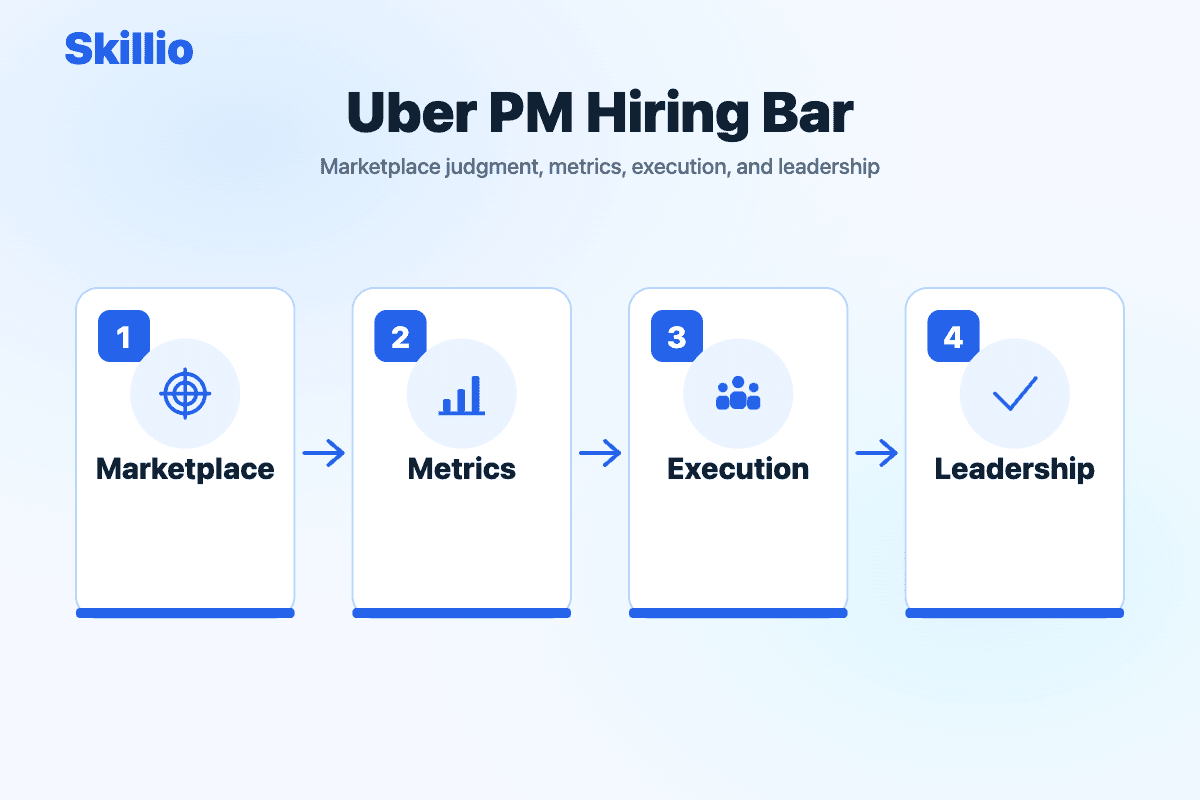
The strongest candidates connect user needs, marketplace health, operational reality, and measurable business outcomes instead of optimizing one metric in isolation. This guide focuses on marketplace judgment, metrics, execution, and leadership evidence and avoids claims that cannot be verified for a specific opening.
At a Glance
| Question | Practical answer |
|---|---|
| What should I trust most? | The current job description and direct recruiter guidance for the specific role. |
| What varies? | Team, level, location, process details, compensation, and scope can all vary. |
| What is the best preparation? | Match your evidence to the role and make assumptions explicit. |
| What should I avoid? | Guaranteed outcomes, universal timelines, and unsupported acceptance-rate claims. |
1. Marketplace
Map riders, drivers, eaters, couriers, merchants, and internal operators where relevant. Start with the exact job description and the evidence available to you. Avoid treating a company-wide pattern as a promise for every team, level, geography, or hiring cycle.
A useful check is to write down the claim you want to make, the evidence that supports it, and the tradeoff or uncertainty you still need to resolve. That keeps the decision specific and makes recruiter conversations more productive.
2. Metrics
Define a metric tree and anticipate second-order effects. Start with the exact job description and the evidence available to you. Avoid treating a company-wide pattern as a promise for every team, level, geography, or hiring cycle.
A useful check is to write down the claim you want to make, the evidence that supports it, and the tradeoff or uncertainty you still need to resolve. That keeps the decision specific and makes recruiter conversations more productive.
3. Execution
Explain city-level constraints, safety, reliability, incentives, and supply-demand tradeoffs. Start with the exact job description and the evidence available to you. Avoid treating a company-wide pattern as a promise for every team, level, geography, or hiring cycle.
A useful check is to write down the claim you want to make, the evidence that supports it, and the tradeoff or uncertainty you still need to resolve. That keeps the decision specific and makes recruiter conversations more productive.
4. Leadership
Respond to Jam-style pushback by updating assumptions without losing structure. Start with the exact job description and the evidence available to you. Avoid treating a company-wide pattern as a promise for every team, level, geography, or hiring cycle.
A useful check is to write down the claim you want to make, the evidence that supports it, and the tradeoff or uncertainty you still need to resolve. That keeps the decision specific and makes recruiter conversations more productive.
Build an Evidence Scorecard
Create one row for each important requirement. Record your strongest example, the result, the people involved, and the risk or tradeoff you managed. Strong evidence is specific enough that an interviewer or recruiter can understand your contribution without guessing.
| Requirement | Evidence to capture |
|---|---|
| Product judgment | User problem, alternatives considered, and why you chose the direction |
| Execution | Prioritization, constraints, delivery decisions, and measurable result |
| Analytics | Metric definition, diagnosis, decision, and second-order effects |
| Leadership | Stakeholders, conflict, your action, and the outcome |
Questions to Ask the Recruiter
- What level and scope is the team hiring for?
- Which product surface, customer group, or market would the role own?
- Which parts of the process are fixed and which depend on the team?
- What evidence would distinguish a strong candidate for this opening?
- Are there location, travel, or office expectations that are not obvious from the listing?
Common Mistakes
The biggest mistake is using generic company prestige as a substitute for role fit. Other avoidable misses include repeating the job description without evidence, presenting compensation as a single number, assuming every team follows the same process, and hiding uncertainty instead of asking a precise question.
A 30-Minute Review
Spend ten minutes matching the opening to your evidence, ten minutes checking the role-specific unknowns, and ten minutes writing the questions you need answered. If the page concerns an interview or offer decision, add a short decision log so you can compare new information without moving the goalposts.
Frequently Asked Questions
Is this process identical for every Uber PM role?
No. Team, level, location, product area, and hiring cycle can change the details. Use this guide as a preparation framework and verify the current opening directly.
Should I rely on reported salary or interview data?
Use external reports as directional context only. Confirm the level, location, scope, and package components for the actual role before making a decision.
What is the strongest signal I can control?
Clear, relevant evidence. Show what you decided, why, how you worked with others, what changed, and what you learned.