Google PM Interview Questions: 25 Examples
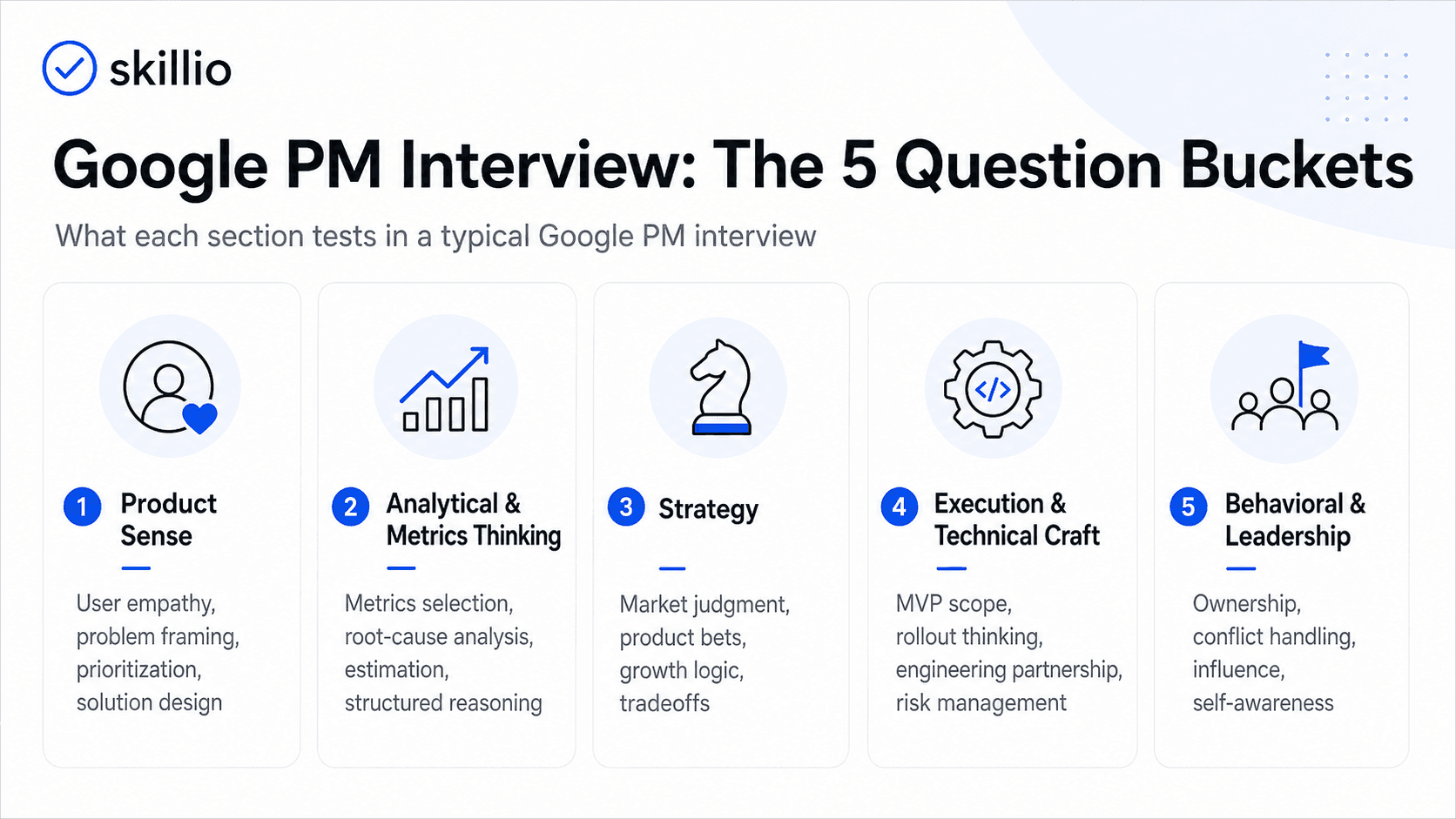
A Google PM interview is rarely just a test of product intuition. It is a structured evaluation of how you think, how you make decisions, how you work with ambiguity, and how well you can communicate tradeoffs under pressure.
That is why candidates who prepare with random product manager prompts often underperform. The better approach is to study Google PM interview questions by category and understand the signal behind each one.
In this guide, we break down the most common categories in a Google product manager interview, explain what each section is testing, and give you 25 representative questions to practice. The goal is not to memorize answers. It is to understand how Google evaluates product managers.
These examples are based on actual experiences of candidates who have successfully cleared the Google PM interview in the last 3 years.
| Google PM interview bucket | What it tests |
|---|---|
| Product Sense | Your ability to understand users, identify meaningful problems, prioritize pain points, and design practical product solutions. |
| Analytical / Metrics | Your ability to choose the right metrics, debug metric changes, estimate with assumptions, and make data-informed decisions. |
| Strategy | Your ability to evaluate markets, competition, growth opportunities, tradeoffs, and long-term product direction. |
| Execution / Technical Craft | Your ability to define MVPs, evaluate rollouts, work with engineering constraints, and ship products responsibly. |
| Behavioral / Leadership | Your ability to collaborate, handle conflict, influence stakeholders, learn from mistakes, and show ownership. |
How Google PM Interviews Are Typically Structured
The typical Google PM interview includes several recurring buckets:
- Product sense
- Analytical and metrics thinking
- Strategy
- Execution and technical craft
- Behavioral and leadership
Different interviewers may blend categories, but the underlying evaluation is consistent. Google wants PMs who can reason clearly, stay user-focused, use data well, and influence teams without relying on authority.

1. Product Sense Questions
What this section is
Product sense questions test whether you can identify user problems, prioritize needs, and design solutions that are both useful and realistic. In a Google product manager interview, this section often focuses less on flashy ideas and more on structured thinking.
What interviewers are looking for
Interviewers usually want to see:
- Clear identification of the target user
- A strong definition of the core problem
- Thoughtful prioritization of pain points
- Practical solutions instead of feature dumping
- Metrics that connect the solution to outcomes
Strong candidates do not jump straight into features. They first clarify goals, narrow the user segment, and explain why one problem matters more than another.
5 Google PM product sense questions
- How would you improve YouTube’s recommendation algorithm?
- Design something for Google Meet.
- How would you improve Google Chrome?
- What is your favorite product, and why?
- Design a product that improves work-from-home productivity.
How to approach product sense questions
A good structure is:
- Clarify the product goal.
- Define the target users.
- Identify pain points.
- Prioritize one or two high-impact problems.
- Propose solutions with tradeoffs.
- Define success metrics.
In Google PM interview questions like these, the interviewer is usually less interested in whether your exact feature idea is brilliant and more interested in whether your reasoning is disciplined.
2. Analytical and Metrics Questions
What this section is
Analytical questions test whether you can use data to investigate issues, choose meaningful metrics, and reason quantitatively. This is a core part of the Google PM interview process because Google expects PMs to be highly data-driven.
What interviewers are looking for
Interviewers typically look for:
- Comfort with ambiguity and incomplete information
- Structured hypotheses instead of guesswork
- Good metric selection
- Ability to separate symptoms from root causes
- Quantitative reasoning under time pressure
You do not need perfect arithmetic. You do need a clean process. Google generally values how you break down the problem more than whether your estimate is exact.
5 Google PM analytical questions
- Imagine you are the PM for YouTube Analytics. What are your 3 most important metrics?
- Gmail’s received-email volume drops 15% over the weekend. What would you do?
- How many messages per second does Gmail receive?
- Estimate how much time people spend at stop lights each year.
- How many lights are on in San Francisco at 8 p.m. on an average day?
How to approach analytical questions
For metric questions, define:
- The product goal
- Leading vs. lagging indicators
- Guardrail metrics
- Possible tradeoffs
For estimation or debugging questions, use:
- Clarify the problem.
- Break it into components.
- State assumptions.
- Do the math cleanly.
- Sanity-check the result.
Many Google product manager interview questions in this category are designed to test calm reasoning, not trivia.
3. Strategy Questions
What this section is
Strategy questions evaluate your ability to think beyond the immediate feature level. They test whether you understand markets, competition, expansion logic, long-term product bets, and business tradeoffs.
This is where the Google PM interview starts to feel less like feature design and more like general management judgment.
What interviewers are looking for
Interviewers are usually testing for:
- Market awareness
- Ability to frame the decision clearly
- Understanding of tradeoffs and risks
- Prioritization under uncertainty
- Long-term product thinking
The best answers connect user value, market conditions, and business logic. Weak answers stay vague or jump to conclusions without a decision framework.
5 Google PM strategy questions
- How would you double YouTube’s user base?
- If you were a PM in Google’s consumer hardware organization, what would you build next?
- How would you go about mapping an unmapped area?
- How do you see the creator economy evolving over the next 10 years?
- You are launching Google Maps in Argentina vs. Brazil. How would you choose between the two markets?
How to approach strategy questions
A useful structure is:
- Clarify the objective.
- Define the decision criteria.
- Assess the market, users, and competition.
- Identify risks and constraints.
- Recommend a direction.
- Explain tradeoffs.
This category is important because many google pm interview questions and answers fail when candidates treat strategy like brainstorming instead of decision-making.
4. Execution and Technical Craft Questions
What this section is
Execution and technical craft questions test whether you can work like a PM inside a complex engineering organization. That includes evaluating rollouts, understanding systems at a high level, defining MVPs, and making sound product decisions with technical constraints in mind.
For some roles, this section can be more technical. For others, it focuses more on execution judgment.
What interviewers are looking for
Interviewers usually want evidence of:
- Structured execution thinking
- Comfort working with engineers
- Ability to evaluate risks and dependencies
- Practical rollout and experimentation judgment
- Basic system understanding without unnecessary jargon
You do not need to answer like an engineer. You do need to show that you can partner effectively with engineering and make technically informed product decisions.
5 Google PM execution and technical questions
- Search Snippets engineers propose an algorithm improvement. How would you evaluate and roll it out?
- If you had to build a basic version of Google Maps, what information would you gather first and what would the MVP include?
- You have seed funding to pursue any product opportunity. What would you build, why, and what would the user journey look like?
- What happens on the back end when a user clicks Search on Google?
- How do you approach GenAI safety in consumer products?
How to approach execution and technical questions
A strong response typically covers:
- Goal and constraints
- Stakeholders and dependencies
- MVP scope
- Risks and failure modes
- Rollout plan
- Success metrics
This section matters because a strong Google product manager interview candidate is not just creative. They can also ship.
5. Behavioral and Leadership Questions
What this section is
Behavioral questions test how you work with others, how you handle conflict, how you make decisions, and whether your working style fits Google’s expectations around collaboration and leadership.
In many cases, these questions carry more weight than candidates expect.
What interviewers are looking for
Interviewers typically want to see:
- Self-awareness
- Clear ownership
- Good judgment under pressure
- Cross-functional influence
- Ability to handle disagreement productively
- Specific examples with measurable outcomes
The strongest answers are concrete. They explain the situation, your role, the challenge, what you did, and what changed as a result.
5 Google PM behavioral questions
- Why do you want to work at Google?
- Tell me about a time you used data to make a decision.
- Tell me about a time you faced conflict.
- Tell me about a time you handled a difficult stakeholder.
- Tell me about a time you made a mistake.
How to approach behavioral questions
Use a tight story structure:
- Situation
- Task
- Action
- Result
- Reflection
For a Google PM interview, reflection is often the missing piece. Strong candidates do not just describe what happened. They explain what they learned and how they changed their approach.
What Google PM Interviewers Want Across All Sections
Even though the categories are different, the signals repeat. Across most Google PM interview questions, interviewers are looking for a few common qualities:
- Structured thinking
- User empathy
- Strong prioritization
- Comfort with ambiguity
- Data-driven judgment
- Clear communication
- Good tradeoff awareness
- Collaborative leadership
If your answers feel scattered, overlong, or overly abstract, that usually hurts performance more than having an imperfect conclusion.
Common Mistakes Candidates Make
Here are some of the most common mistakes in a Google product manager interview:
- Jumping into solutions before clarifying the problem
- Listing too many features without prioritization
- Choosing vague metrics like “engagement” without defining them
- Ignoring tradeoffs and risks
- Giving behavioral answers with no measurable outcome
- Sounding polished but not structured
The best preparation is active practice. Do not just read Google PM interview questions. Answer them out loud, time yourself, and refine your structure.
FAQ: Google PM Interview Questions
Are Google PM interview questions always about Google products?
No. Many are about Google products such as YouTube, Gmail, Chrome, Maps, or Search, but many are broader product, estimation, or leadership prompts. What makes them relevant is that they are used in the Google PM interview, not that they are always Google-branded.
How many types of Google PM interview questions should I prepare for?
At minimum, prepare for five buckets:
- Product sense
- Analytics
- Strategy
- Execution and technical craft
- Behavioral and leadership
How technical is the Google PM interview?
It depends on the role, but most candidates should expect at least some technical or execution-oriented questioning. You usually do not need deep coding knowledge, but you should understand systems, tradeoffs, and how products get built.
What is the best way to prepare for Google PM interview questions?
The most effective method is to practice by category, use a repeatable framework, and review your answers for structure, prioritization, and clarity.
Final Thoughts
If you are preparing for a Google PM interview, do not treat it like a random mix of case questions. Treat it like a structured evaluation across product sense, analytics, strategy, execution, and leadership.
That mindset changes how you prepare.
When you understand what each section is, what interviewers are looking for, and how to answer with structure, Google product manager interview questions become much more manageable.
If you want to go one step further, build a practice plan around these five categories and rehearse one strong framework for each. That is usually more effective than trying to memorize dozens of answers.